
Car polishing: Get a free quote
Does your car need polishing?
A shiny and polished car is something most car owners dream of. Regular polishing is the key to maintaining that deep shine and protecting the paint from wear and tear and external influences.
Here we take a closer look at what polishing is, what benefits it brings and how to get the best results – whether you choose to do it yourself or leave it to a professional.
Get a free quote for car polishing
Send us a short description of your wishes and needs, and we’ll help you find the best suited car care professional for your car.
Your contact information will only be used in connection with the request. Your personal data will not be disclosed to unauthorized persons.
What does car polishing cost?
How much it costs to polish a car depends on the size of the car, the condition of the paintwork and the type of treatment you want. Prices also vary quite a bit between the different providers.
A simple polish usually costs between NOK 1,500-3,000 for an average car. This is suitable for cars with few scratches and wear and tears and gives a nice refreshing shine.
If you want a more thorough machine polishing with correction of deeper scratches and defects, expect to pay NOK 3,000 and up. This is a time-consuming process that requires special tools and experience for the best possible results.
At the top end, you’ll find various polishing packages with more extensive content. Such a package may include machine polishing with correction, waxing/sealing and paint protection. We’re talking NOK 5,000-10,000 depending on car size and time spent. In return, you get a virtually new paint finish that lasts for a long time.
Is it necessary to polish the car?
Whether polishing is necessary depends on the car’s age, use and, not least, the owner’s requirements for appearance and finish. Strictly speaking, polishing is an optional treatment, but most cars will benefit from it on a regular basis.
The main reason for polishing is to remove small scratches and oxidation in the paint. Over time, weather, wind and daily use will leave their mark in the form of so-called swirls – tiny scratches that make the paint dull and lifeless. Polishing evens out these scratches and restores depth and shine.
Polishing also has a protective effect. By removing the top, damaged layer of the paint, the surface becomes more resistant to new wear and external influences. Particularly in winter, this is beneficial to avoid permanent damage from salt, sand and dirt.
Polishing is a great way to prepare the car before applying wax, sealer or ceramic coating. By creating a clean and smooth surface, the protection will adhere better and last longer.
Although polishing is not a necessity, it is definitely worth considering on a regular basis. How often depends on use and wear and tear, but a good rule of thumb is 1-2 times a year to keep the paint in tip-top condition.
When is it best to polish the car?
It is recommended to polish your car 1-2 times a year to keep the paint in the best possible condition. Many people choose to do it in the spring and fall.
Assuming that the car is only polished once a year, fall is definitely the best time to do it. Throughout the winter, your car is exposed to a lot of dirt, salt, particulate matter and other chemicals from the winter roads. This gets stuck in the paint and can cause oxidation, discoloration and, in the worst case, rust if not adequately protected. By polishing your car in the fall, you get a good starting point for the harsh winter.
A shiny and well-polished surface also makes it easier to wash and keep your car clean throughout the winter. Dirt and salt won’t stick as easily, and you’ll reduce the risk of permanent paint damage come spring.
Of course, the best thing to do is to give your paintwork a good polish both in the fall and spring, if time and budget allow. But if you have to prioritize one annual polish, autumn is definitely the smartest choice.
In the spring, the focus is first and foremost on washing away all traces of the winter’s wear and tear through a thorough wash and clean. From there, you have a good starting point for any polishes and wax treatments needed for summer activities.
What happens when you polish a car?
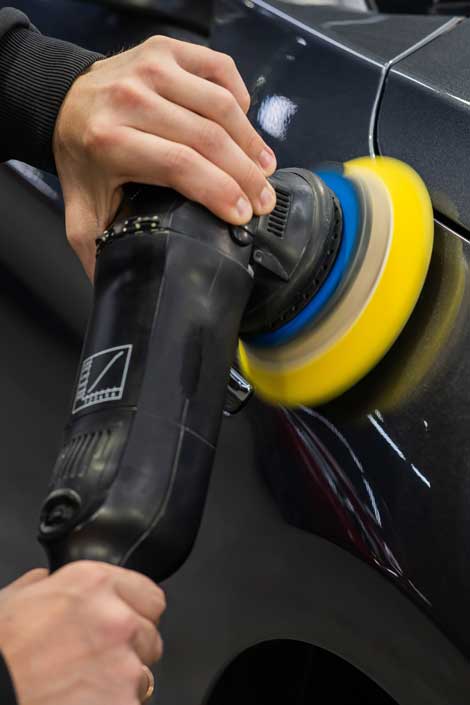
When you polish a car, the top layer of the clear coat is sanded down using abrasive polishing paste and a polishing machine or pad. The purpose is to smooth out small scratches, damage and irregularities in the clear coat so that the surface is smooth and shiny.
The process usually consists of several steps with progressively finer polishes and softer pads. The coarseness of the paste and abrasive pads determines how aggressively it is sanded and is adapted to the depth of the scratches and the hardness of the paint.
Typically, you start with a coarse rubbing paste to wear down scratches. This is followed by a finer polish to remove sanding marks and restore shine. The final step is often a fine polish or wax for protection and a deep shiny finish.
The whole process requires precise machine control and even pressure to avoid sanding through or burn marks. You also need to work section by section, alternating lengthwise and crosswise, to get an even result. The end result of a successful polish is a restored, shiny and scratch-free surface.
What kind of scratches can be polished off?
Polishing is an effective way to remove small to medium-depth scratches in car paint. We’re talking about superficial scratches that are only in the clear coat and don’t go all the way down to the base coat or the metal underneath.
Typical scratches that can be polished away are:
- Washing scratches (swirls): Tiny, circular scratches caused by incorrect washing methods or equipment. Best seen in bright light.
- Spider webbing scratches (spider webbing): Thin, wild scratches in all directions, often caused by sanding with dirty cloths.
- Oxidation: Matt, discolored surface as a result of UV radiation and pollution. Common on older paintwork.
- Fine scratches: Minor scratches from clothes, jewelry, shopping bags etc. They are often so small that they cannot be felt with the nail.
Unfortunately, deeper scratches that go through the clear coat and down to the base coat or metal cannot be removed by polishing alone. These need to be filled and repainted for a perfect result. If you are good at polishing, you can camouflage such damage to some extent with polishing, but they will still be visible on closer inspection.
Are waxing and polishing the same thing?
Polishing and waxing are not the same thing, although the terms are often used interchangeably. Both are about treating your car’s paintwork but have different purposes and are carried out in different ways.
Polishing is a mechanical process where you grind down the top layer of the clear coat to remove scratches, oxidation and damage. This is done with polishing paste and a machine or polishing sponge. The purpose is to smooth out irregularities so that the surface becomes smooth and shiny.
Waxing is a protective treatment that leaves a thin layer of natural or synthetic wax on top of the paint. This acts as a barrier against sun, weather, pollution and light abrasion. Wax also gives a deep and wet shine but does not fill any scratches.
Polishing should be carried out 1-2 times a year, while waxing can easily be carried out 2-4 times a year depending on the desired protection and shine. Wax gradually breaks down and washes away faster than a polished lacquer and needs to be renewed more often.
Ideally, you should polish first to create a clean and smooth surface. Then finish with a protective layer of wax or sealer for long-lasting shine. Only waxing without prior polishing will not remove deep damage and the result will be short-lived.
In summary, polishing is a corrective treatment that fixes damage, while waxing is a protective treatment that prevents damage. Both have their purpose and are often used in combination for lasting paint care and protection.
What is the difference between paint cleaning and polishing?
Paint cleaner and polish are both used to refresh your car’s paint, but they have different functions:
- Paint cleaner is a chemical product that dissolves and removes dirt, tar and grime that sticks to the outside of the paint over time. It is a temporary cleaner before polishing or waxing, to get a completely clean surface. Paint cleaner is applied with a cloth and wiped off again.
- Polishing grinds down the top layer of the clear coat to smooth out scratches and oxidation. It is a mechanical process that uses abrasive polishing particles to smooth out irregularities, making the paint smoother and more reflective. Polishing is done when needed and removes a thin layer of the clear coat.
Can you polish the car yourself?
It is entirely possible to polish your car yourself if you have the time, patience and the right equipment. It takes some practice and experience to achieve a good result, but with good research and the right procedures, it’s definitely doable.
The advantage of polishing yourself is that you have full control over the process and can tailor the treatment to the condition of the car and your own preferences. You’ll also save a lot of money compared to taking your car to a professional.
The downside is that it can quickly become time-consuming, especially if the paintwork is in poor condition. It also requires a certain amount of investment in equipment such as a polishing machine, cushions, polishing products and various supplies for preparation and cleaning.
It also entails a risk of making mistakes that result in sanding through scratches or holograms in the paint. This is caused by too aggressive polishing, too much pressure or incorrect technique. Beginners should therefore start cautiously with hand polishing and fine products before getting to grips with the machine.
For the vast majority of people, it will be worthwhile to have their car polished by a professional. They have the expertise, experience and professional equipment to deliver a good result in a short time.
Can you polish by hand?
It is possible to polish a car by hand, although it is more time-consuming and gives somewhat limited results compared to a machine polish.
Hand polishing is best suited as a maintenance polish on relatively new paintwork, or to remove light swirls and oxidation.
The disadvantage of hand polishing is that it requires quite a lot of time and effort to go over the entire car. It can also be difficult to achieve a complete result and avoid scratches and holograms.
For deeper scratches, there’s not enough power and speed to sand them down completely.
For most people, machine polishing is recommended for optimal effect and finish. But for beginners or those with lightly worn paint, hand polishing can be a good alternative that protects your paint and your wallet.
Start small, in a less visible area, and work your way up as you get the hang of the technique.
How long does it take to polish a car?
The time it takes to polish a car varies depending on several factors:
- The size of the car – a larger car requires more time than a small car.
- The condition of the paint – worn and scratched paint requires more work.
- Desired result – a quick touch-up is faster than a thorough polishing.
- Equipment – machine polishing is more efficient than hand polishing.
- Experience – a professional will work faster than a beginner.
A professional can estimate 4-8 hours for an average car, including washing and waxing. Particularly demanding cars can take 1-2 days.
If you do it yourself, you should set aside at least one day if you don’t have much previous experience. In addition, you need to allow time for a thorough wash beforehand, and preferably apply a protective wax or sealant afterwards.
How to wash the car before polishing?
Preparation is essential for a good result, and it is incredibly important that the car is thoroughly washed before the polishing job begins.
- Start with a pre-wash to dissolve the worst dirt. Feel free to use foam and a high-pressure washer.
- Wash the rims thoroughly with your own rim brush and shampoo.
- Wash the rest of the car with a suitable shampoo and microfiber washcloth. Start at the top and work your way down. Rinse the mitt often.
- Rinse thoroughly and dry with a microfiber towel. Pay close attention to doors, cavities and cracks.
- Use clay to remove the last traces of dirt in the paint. You can use a clay bar, clay sponge or a clay cloth.
Important tips along the way:
- Wash in the shade on cooled paint to prevent drying shadows.
- Only use clean cloths and pH-neutral shampoo.
- Never mix equipment used on chassis/wheels and paintwork.
- Good lighting is important to ensure that all surfaces are clean before polishing.
How do I get a quote for car polishing?
To get a quote for car polishing, you’ll need to get in touch with a polisher, and the quickest way to get in touch is through us. It can be time-consuming to research all the car polishers in your area and decide which one you should actually choose. We work with professional operators across the country who have extensive experience in car polishing and can easily put you in touch with a reliable operator near you.
Fill in the form with some information about your wishes and needs, and we’ll forward your enquiry to the company in your area that best matches your assignment. The service is free and completely non-binding.